Alloy 840 (UNS S33400 / 1.4847) is a titanium- and aluminum-bearing austenitic stainless steel designed for sustained service in oxidizing and carburizing environments up to 1038°C (1900°F). The controlled addition of Ti and Al to a 20Cr-20Ni base enhances oxide scale adhesion and improves high-temperature structural stability beyond conventional 18-8 grades .
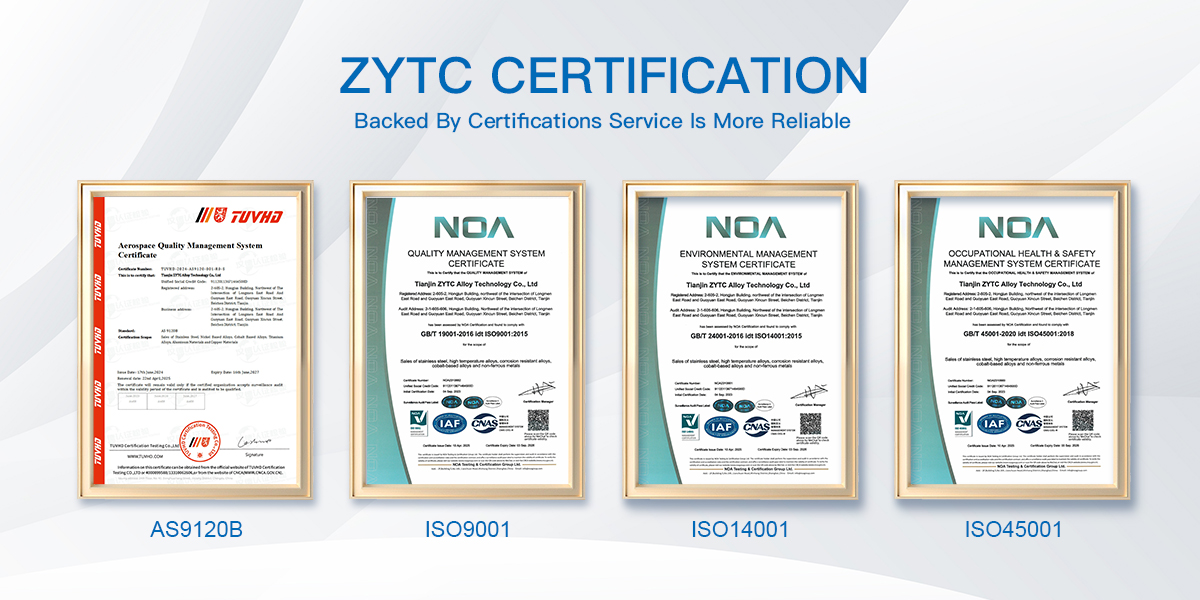
1. Product Specifications & Physical DataZYTC Alloy supplies UNS S33400 in mill forms suitable for heating element fabrication and furnace component manufacturing, with ISO 9001 and AS9120 certification. Available Forms: Sheet, plate, strip, tube (seamless/welded), rod, bar, wire, and custom forgings. Specifications: ASTM B409, B514, B515, B536; DIN 1.4847.
| Chemical Composition (Weight %) | Alloy 840 Specification |
|---|
| Chromium (Cr) | 18.0 - 22.0 | | Nickel (Ni) | 18.0 - 22.0 | | Titanium (Ti) | 0.15 - 0.60 | | Aluminum (Al) | ≤ 0.60 | | Carbon (C) | ≤ 0.08 | | Silicon (Si) | ≤ 1.00 | | Manganese (Mn) | ≤ 1.00 | | Iron (Fe) | Balance |
| Physical Properties | Metric | Imperial |
|---|
| Density | 7.92 - 8.08 g/cm³ | 0.286 - 0.292 lb/in³ | | Melting Range | 1385°C (approx.) | 2525°F (approx.) |
| Mechanical Properties (Annealed) | Metric | Imperial |
|---|
| Tensile Strength | 515 - 572 MPa | 74.7 - 83 ksi | | Yield Strength | 241 - 275 MPa | 35 - 39.9 ksi | | Elongation at Break | 40 - 45% | 40 - 45% |
2. Operating Conditions & Selection CriteriaAlloy 840 (UNS S33400 / 1.4847) bridges the gap between standard austenitic stainless steels and higher-cost nickel alloys for moderate-temperature oxidation service. Its primary value lies in long-term scaling resistance rather than load-bearing capacity at extreme temperatures. Service Temperature Range: Continuous service up to 1038°C (1900°F) in oxidizing atmospheres; suitable for cyclic conditions up to 900°C for mechanical components . Oxidation Resistance: Forms a dense, adherent Cr₂O₃ scale that resists spalling under thermal cycling. Performance superior to Type 304 and comparable to higher-alloyed grades up to the maximum use temperature . Environmental Resistance: Good resistance to carburization and sulfidation in combustion atmospheres. Titanium stabilization prevents sensitization and intergranular corrosion after welding or thermal exposure . Mechanical Limits: Not intended for high-stress applications above 600°C; creep strength diminishes rapidly above this range. Suitable for non-critical structural components and thin-section heating elements .
3. Fabrication & Material ComparisonAlloy 840 (UNS S33400 / 1.4847) offers excellent formability and weldability similar to standard austenitic grades, though its work-hardening rate requires consideration during severe cold forming. Machining: Work-hardens during cutting; machinability comparable to 304 stainless. Carbide tooling recommended with positive rake angles. Water-based coolants for high-speed operations; sulfurized oils for tapping and drilling. Welding: Good weldability using GTAW, SMAW, GMAW. Matching filler metals (ERNiCr-3 or similar) recommended to maintain corrosion resistance. Pre-weld cleaning essential; post-weld heat treatment not typically required . Forming & Heat Treatment: Hot Working Range: 1000-1200°C (1832-2192°F) Annealing: 1038-1121°C (1900-2050°F) followed by rapid cooling Cold Working: Responds to conventional methods; intermediate annealing may be required for severe deformation .
Material Comparison: vs. Type 304: Significantly better oxidation resistance above 800°C; preferred for continuous high-temperature exposure. vs. Type 310S: Lower chromium (20% vs. 25%) but comparable oxidation resistance up to 1038°C due to Ti-Al stabilization; more cost-effective where extreme creep strength not required . vs. Alloy 600: Lower nickel content reduces cost; suitable where aqueous corrosion resistance not the primary driver.
Applications Electric heating element sheaths (rods, tubes, coils) Hot runner system components Thermocouple protection tubes Industrial furnace fixtures, muffles, and radiant tubes Automotive emission control components Heat treating baskets and trays Chemical processing tanks for water, oil, and mild acids
Contact ZYTC Alloy for certified alloy 840 materials with complete traceability, technical datasheets, and competitive pricing on standard sizes or custom-fabricated components. Email:daisy@zytcsteel.com WhatsApp/WeChat: +86 17335753350 |