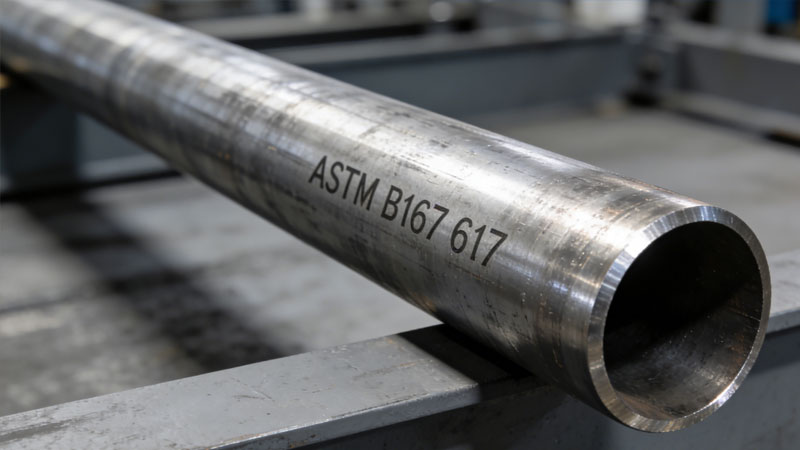
ZYTC Alloy Delivers ASTM B167 Alloy 617 Seamless Pipe for Oil Industry Applications
Alloy 617 for Oilfield High-Temperature Service: Selection Limits and a Recent Delivery Case
For HTHP wellhead, surface flow line, and heat exchanger design engineers — this case study examines the real selection boundaries of Alloy 617 (UNS N06617) in oilfield service, based on a recent seamless pipe delivery by ZYTC Alloy, an ISO 9001 certified manufacturer.
Looking for full Alloy 617 specifications?
The Delivery Case: What Was Supplied and Why
ZYTC recently delivered a batch of ASTM B167 Alloy 617 seamless pipe to an oilfield equipment fabricator for use in a high-temperature heat exchanger application.
Shipment details:
-
Form: Cold-drawn seamless pipe, solution annealed per ASTM B167 / ASME SB167
-
Size range: OD 60–114 mm, wall thickness 5–12 mm (specific sizes per customer drawing)
-
Certification: EN 10204 3.1 with actual chemistry and mechanical test values
-
Service condition: The heat exchanger operates at approximately 700–750°C with trace H₂S content (partial pressure in the low range) and no elemental sulfur deposition risk. The end user selected Alloy 617 because creep strength at temperature was the primary design criterion, and the oxidizing-dominant atmosphere favored its high-chromium, solid-solution-strengthened metallurgy.
This is not a case of “Alloy 617 is corrosion-resistant, so we used it.” The selection was based on a specific assessment of the service environment—and a clear understanding of where Alloy 617’s limits lie.

Where Alloy 617 Works—and Where It Doesn't
Alloy 617 (UNS N06617) is a solid-solution-strengthened nickel-chromium-cobalt-molybdenum alloy with excellent high-temperature strength and oxidation resistance below 982°C. ASME approves it for service up to 982°C. However, oilfield environments differ from gas turbines or heat-treat furnaces: the corrosion risk comes from the coupled action of H₂S, CO₂, chlorides, and elemental sulfur, not high-temperature oxidation alone.
Alloy 617 is a reasonable candidate when all of the following apply:
-
Service temperature is above 650°C, with a need for long-term creep strength
-
The medium is predominantly oxidizing, or H₂S/CO₂ partial pressures are in the low-to-moderate range
-
Elemental sulfur content is controlled, or there is no deposition risk
Re-evaluate Alloy 617—or consider alternatives—under these conditions:
① Elemental sulfur deposition risk: Published laboratory data indicate that at an elemental sulfur concentration of 10 g/L, the Cr₂O₃ passive film on Alloy 617 undergoes selective dissolution, and the uniform corrosion rate can rise to approximately 5.2 mm/a, with corrosion products dominated by Cr₂S₃ and NiS. Source: published high-temperature corrosion studies on Ni-Cr-Mo alloys in sulfur-bearing environments. This rate is unacceptable for long-service tubulars.
② Sour service below 650°C (H₂S-dominated): Alloy 617's high-temperature strength advantage is not utilized, and its corrosion resistance may not exceed alloys specifically designed for sour service (e.g., Alloy 625 or C276 under specific conditions).
③ Refining environments requiring resistance to polythionic acid SCC: Annealed Alloy 617 is susceptible to polythionic acid SCC. Patent literature notes that a 732–927°C heat treatment can form a discontinuous grain-boundary carbide network to inhibit crack propagation—but this is not the standard supply condition and must be specified separately.
Procurement action: Provide actual partial pressure data (H₂S, CO₂, elemental sulfur content, chloride concentration) and service temperature in the inquiry. We confirm whether Alloy 617 fits before quoting—we do not assume “corrosion-resistant alloy = oilfield-ready.”
Seamless Pipe Specifications & Supply
| Item | Parameter |
|---|---|
| Standard | ASTM B167 / ASME SB167 |
| Form | Seamless pipe (cold-drawn or hot-rolled) |
| OD range | Confirmed per inquiry |
| Wall thickness range | Confirmed per inquiry |
| Supply condition | Solution annealed |
| Certificate | EN 10204 3.1, with actual chemistry and mechanical test values |
Dimensional tolerance note: ASTM B167 specifies product-specific requirements; dimensional tolerances, ovality, and wall thickness deviation are actually governed by ASTM B829 (general requirements for pipe). If the pipe is for subsequent expansion, bending, or welding, cite B829 alongside B167 on the PO and specify which tolerances require control—do not write only “conforms to B167.”
Other Forms of the Same Grade (Can Be Quoted Together)
| Form | Standard |
|---|---|
| Plate / sheet / strip | ASTM B168 |
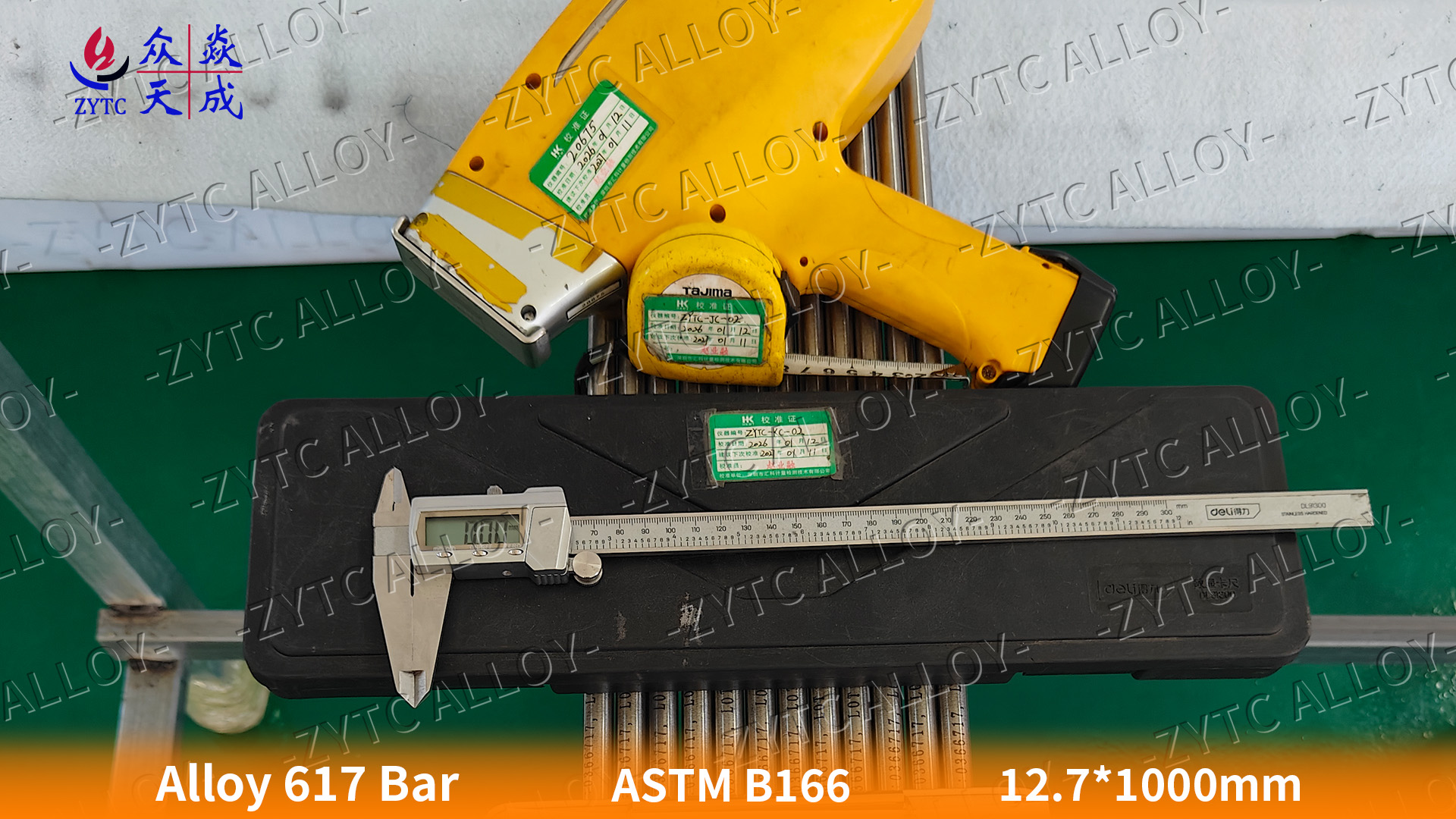
| Bar | ASTM B166 |
| Welding products | ERNiCrCoMo-1 (AWS A5.14) |
| Forgings | ASTM B564 |
Why Source from ZYTC
-
Service condition matching: We do not assume Alloy 617 suits every oilfield scenario. Provide partial pressures and temperature in the inquiry, and we will confirm suitability or suggest alternatives.
-
Dimensional standard alignment: ASTM B829 can be cited alongside B167 to control pipe tolerances on request.
-
Traceable certification: EN 10204 3.1 certificate with actual chemistry and mechanical test values.
-
Form consolidation: Pipe, plate, bar, and welding products supplied under a single traceability system.
-
Lead time: Standard sizes 7–10 days; non-standard sizes or third-party-tested orders 3–4 weeks; FOB terms.
Request a Quote
Please provide: OD, wall thickness, length, quantity, service temperature, H₂S/CO₂ partial pressures, elemental sulfur content (if any), and whether ASTM B829 or third-party testing is required.
If the service involves elemental sulfur deposition or a sour environment below 650°C, note this in the inquiry—we will confirm material suitability before quoting.
📧 Email: daisy@zytcsteel.com
📲 WhatsApp/WeChat: +86 17335753350
Application of High-Temperature Alloys in Oil and Gas
Titanium Alloy Grades and Properties
Related Article