MP159 (UNS R30159) Engineering Process Control Guide: Cold Working & Aging Parameters
MP159's strength is not a fixed "material property"—it is a process outcome. From the same VIM+VAR melted bar stock, a few percentage points difference in cold reduction or a dozen degrees deviation in aging temperature can shift the final tensile strength by more than 200 MPa. This guide focuses on the process window control between the solution-annealed state and final service performance, and on the critical parameters that must be locked down in a procurement technical agreement. The product page answers "what the material is"; this guide answers "how to ensure it reaches design strength."
Why the "Specification Strength" of MP159 Cannot Be Taken at Face Value
AMS 5842 specifies a minimum tensile strength of 260 ksi (approximately 1790 MPa) for cold-drawn MP159 bar after cold working plus aging. But this is a lower limit, not a guaranteed value.
Actual strength depends on the interaction of three variables:
-
Cold reduction: The solution-annealed matrix requires sufficient cold work to introduce adequate ε-phase and dislocation density. Published data indicate that 48% cold drawing is the typical process window for achieving the optimal strength-ductility balance.
-
Aging temperature and time: Aging precipitates Ni₃X phases for supplementary strengthening. Too low a temperature results in incomplete precipitation; too high a temperature causes precipitate coarsening. Both reduce strength.
-
Solution treatment before cold working: Incomplete solution treatment leads to non-uniform deformation during subsequent cold working and inconsistent aging response.
Procurement implication: If your technical agreement only states "conforms to AMS 5842," a supplier can theoretically deliver a batch that sits just above the lower limit. For fasteners or critical structural components, that margin may not be sufficient. It is recommended to specify a target strength range in the agreement, rather than citing only the standard minimum.
Cold Working: It Is Not "The More Deformation, The Better"
MP159's strengthening mechanism dictates an optimal window for cold reduction.
Too low a reduction: Insufficient ε-phase induction and inadequate dislocation density mean the post-aging strength will not reach the design target.
Too high a reduction: Strength continues to rise, but ductility drops noticeably. Elongation may slide from 8–12% toward lower values, and for fasteners requiring thread rolling or heading, reduced ductility can lead to cracking during forming.
Typical process window: A cold-drawn reduction of 48% ± 1% is a mature process cited by multiple sources. For non-standard sizes or special forming requirements, this value may need adjustment—but any adjustment must be supported by process validation data, not estimated from experience.
What to confirm during procurement: Whether the supplier's cold-drawing process has been validated for the specific diameter and delivery condition you are ordering. For precision ground bar, centerless grinding after cold drawing removes surface material, and there may be slight differences in deformation between the surface and core—more pronounced on large-diameter bars.
Aging Treatment: The Temperature Window Is More Sensitive Than Time
Aging is the critical step for MP159 to achieve final strength. The typical process is 650–675°C × 4–4.5 h, air cooled. In practice, however, temperature uniformity and furnace temperature control accuracy have a far greater impact on results than minor fluctuations in holding time.
Why the temperature window is narrow: MP159's strengthening relies on the dispersed precipitation of nanoscale Ni₃X phases. At too low an aging temperature, the precipitation driving force is insufficient and strengthening is compromised; at too high a temperature, precipitates coarsen rapidly and strength decreases rather than increases. For large furnace loads or thick-section bars, temperature variation within the furnace can cause inconsistent properties at different positions in the same batch.
What to confirm during procurement: Whether the supplier's aging furnace has a Temperature Uniformity Survey (TUS) report, and whether the report covers the 650–675°C range. For aerospace fastener applications, AMS 5842 imposes additional requirements on heat treatment processes, and the supplier's heat treatment qualifications and furnace records should be traceable.
Key Differences from MP35N: Do Not Mix Specifications During Procurement
MP159 and MP35N are often mentioned together, but their alloy designs and process paths differ, and their specifications are not interchangeable.
| Comparison Item | MP159 | MP35N |
|---|---|---|
| Alloy design | Ti, Nb, Al additions for aging precipitation strengthening | No Ti/Nb/Al; strengthening mainly by cold working + aging |
| Typical cold reduction | ~48% | Can be higher (e.g., 50–60%) |
| Aging temperature | 650–675°C | Approximately 600°C |
| Peak strength | ≥1830 MPa (CW+Aged) | Typically below MP159's peak |
| Ductility | Elongation 8–12% | Generally slightly lower at equivalent strength |
If you apply MP35N process parameters to MP159, the aging temperature may be too high, resulting in strength falling short of target. The procurement technical agreements for the two alloys should be written separately and should not use the same template.
Incoming Inspection: What Must Be Done Beyond the Chemistry Certificate
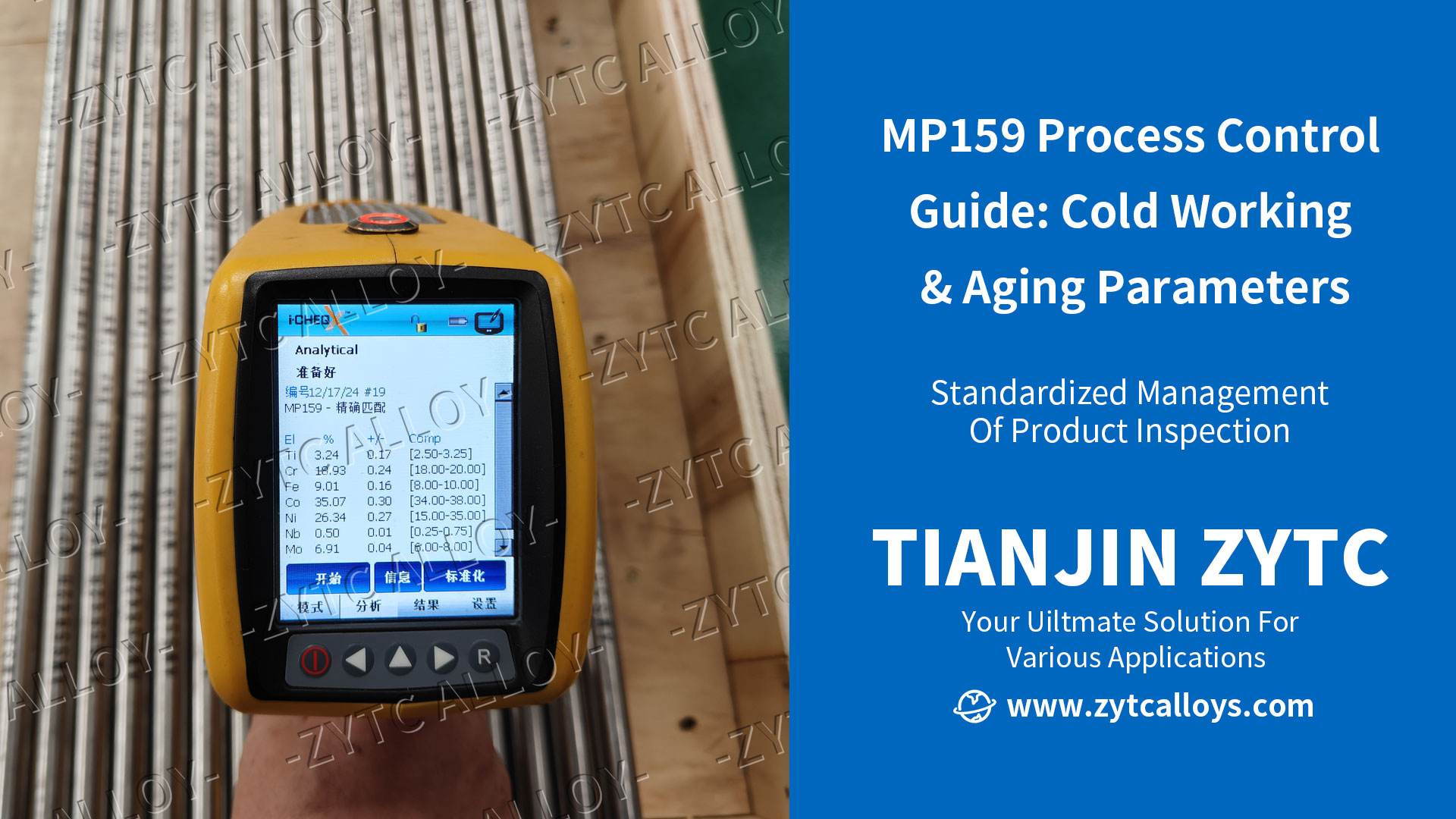
MP159's chemical composition (Co balance, Ni 25.5, Cr 19, Mo 7, Fe 9, Ti 3, Nb 0.6, Al 0.2) is clearly specified in AMS 5842. But chemical compliance does not equal final performance compliance.
Recommended acceptance checks:
| Check Item | Method | Focus |
|---|---|---|
| Delivery condition confirmation | Verify cold worked % and aging parameters on the mill certificate | Whether they match your technical agreement |
| Hardness | Portable or benchtop hardness tester (HRC) | Cold-worked + aged condition should be in the HRC 42–50 range; low hardness suggests insufficient aging or inadequate cold reduction |
| Tensile properties (first article / new supplier) | Sample for room-temperature tensile testing | Confirm whether tensile strength reaches your target value, not just the standard minimum |
| Surface quality (ground bar) | Visual inspection + surface roughness tester | Ground bar should be free of scale, decarburization, and grinding burn marks |
For critical fastener applications: It is recommended to request test data from a witness specimen heat-treated in the same furnace load as your material, rather than relying only on "typical values." A witness specimen is more representative of the actual condition of the batch you receive.
Two Reminders During Machining and Use
Machining: In the cold-worked + aged condition, MP159 has high hardness and a strong work-hardening tendency. Turning and milling require rigid setups, sharp tooling, and adequate coolant. If threads need to be machined after aging, consider the effect of work hardening on tool life.
Welding: MP159 has limited weldability, and its typical application is mechanical fastening rather than welded structures. If welding is required in the design, it must be evaluated separately; do not assume welding behavior identical to solution-annealed MP35N.
Information Required When Requesting a Quote
To receive a meaningful quotation and technical confirmation, please state the following in your inquiry:
-
Product form: Cold-drawn bar, ground bar, wire, or other
-
Dimensions: Diameter and tolerance requirements
-
Delivery condition: Solution annealed, cold worked, or cold worked + aged
-
Target strength (if above the AMS 5842 minimum): Specify expected tensile and yield strength values
-
Application: Fastener, medical component, or other—this influences our recommendations on surface quality and inspection items
-
Certification requirements: AMS 5842 compliance statement, or third-party testing
📧 Email: daisy@zytcsteel.com
📱 WhatsApp/WeChat: +86 17335753350
Beyond 304 Stainless Steel: 4 Alloys with Superior Strength, Corrosion Resistance & Weldability
Choosing the Right MP35N Delivery State: AMS 5758 vs. 5844 vs. 5845L
Related Article