254 SMO is a high-molybdenum (6.1%) and nitrogen-alloyed super austenitic stainless steel offering exceptional resistance to pitting, crevice corrosion, stress corrosion cracking, and corrosion fatigue in aggressive chloride environments. With PRE (Pitting Resistance Equivalent) exceeding 43, it significantly outperforms standard stainless steels and duplex grades in seawater, brine, and acidic chloride solutions. This alloy is the preferred material for offshore platforms, desalination plants, and FGD systems requiring maximum corrosion resistance .
1. Product Specifications & Physical DataZYTC Alloy supplies 254 SMO in comprehensive mill forms for marine, chemical, and industrial applications requiring verified corrosion resistance and complete material traceability. Available Forms: Sheet, plate, pipe, tube, bar, and fittings . Specifications: ASTM A240, ASTM A312, ASTM A479, EN 10088-2 1.4547, UNS S31254 .
| Chemical Composition (Weight %) | 254 SMO Specification |
|---|
| Chromium (Cr) | 19.5 - 20.5 | | Nickel (Ni) | 17.5 - 18.5 | | Molybdenum (Mo) | 6.0 - 6.5 | | Nitrogen (N) | 0.18 - 0.22 | | Carbon (C) | 0.02 max. | | Manganese (Mn) | 1.0 max. | | Silicon (Si) | 0.8 max. | | Phosphorus (P) | 0.030 max. | | Sulfur (S) | 0.010 max. | | Copper (Cu) | 0.5 - 1.0 | | Iron (Fe) | Balance |
| Physical Properties | Metric | Imperial |
|---|
| Density | 8.0 g/cm³ | 0.289 lb/in³ | | Modulus of Elasticity | 195 GPa | 28,300 ksi | | Shear Modulus | 75 GPa | 10,900 ksi | | Poisson's Ratio | 0.30 | 0.30 | | Thermal Conductivity (RT) | 14 W/m·K | 97 BTU·in/hr·ft²·°F | | Coefficient of Expansion (20-100°C) | 16.5 µm/m·°C | 9.2 µin/in·°F |
| Mechanical Properties (Minimum) | Value | Unit |
|---|
| Tensile Strength | 650 MPa | 94 ksi | | Yield Strength (0.2% offset) | 300 MPa | 43.5 ksi | | Elongation | 35% | 35% | | Hardness (Brinell) | 210 max. | 210 max. | | Impact Strength (Charpy V, -196°C) | 50 J | 37 ft·lbf |
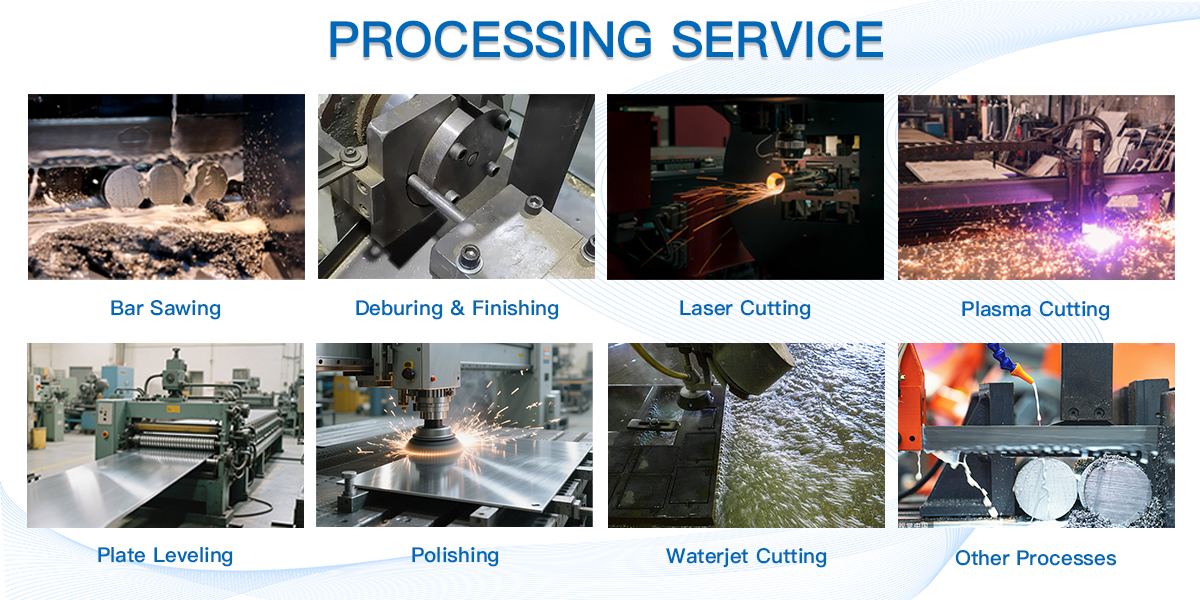
2. Fabrication & Material ComparisonHeat Treatment: Solution anneal at 1150-1200°C (2100-2200°F), rapid water quench; cannot be hardened by heat treatment . Hot Working: Forge at 1150-1250°C (2100-2280°F); reheat as necessary; rapid cooling after working recommended . Cold Working: High work-hardening rate requires more powerful equipment than austenitic grades; intermediate annealing may be required for severe forming . Machining: Challenging due to high work-hardening rate; requires sharp tools, positive feeds, slow speeds, ample lubrication, and rigid setups . Welding: Good weldability using TIG, MIG, and SMAW methods; matching filler metals (ERNiCrMo-3 / Alloy 625) required to maintain corrosion resistance . Material Comparison: vs. 316L Stainless: PRE 43 vs. 25; significantly superior pitting and crevice corrosion resistance; essential for seawater and high-chloride service . vs. Super Duplex 2507: Comparable corrosion resistance; 254 SMO offers better toughness at cryogenic temperatures and remains fully austenitic . vs. Alloy 625: Lower cost alternative with excellent corrosion resistance; 625 required only for severe reducing acid environments .
3. ApplicationsOffshore Oil & Gas: Seawater piping systems, fire-fighting systems, cooling water systems, platform risers Desalination: High-pressure RO plants, evaporators, seawater intake systems, brine heaters Chemical Processing: Heat exchangers, reactors, vessels for chloride-containing media, sulfuric acid service Pulp & Paper: Bleach plants, chlorine dioxide environments, washer drums Flue Gas Desulfurization: Scrubbers, absorber towers, ducting, stack liners Marine: Propeller shafts, seawater cooling systems, ballast water systems Food Processing: Equipment for brine solutions and chloride-containing food products
Contact ZYTC Alloy for certified 254 SMO materials with complete traceability, ASTM/EN specifications, technical datasheets, and competitive pricing on standard sizes or custom-fabricated components. Email: daisy@zytcsteel.com WhatsApp/WeChat: +86 17335753350 |