
Titanium Alloy Grades and Properties
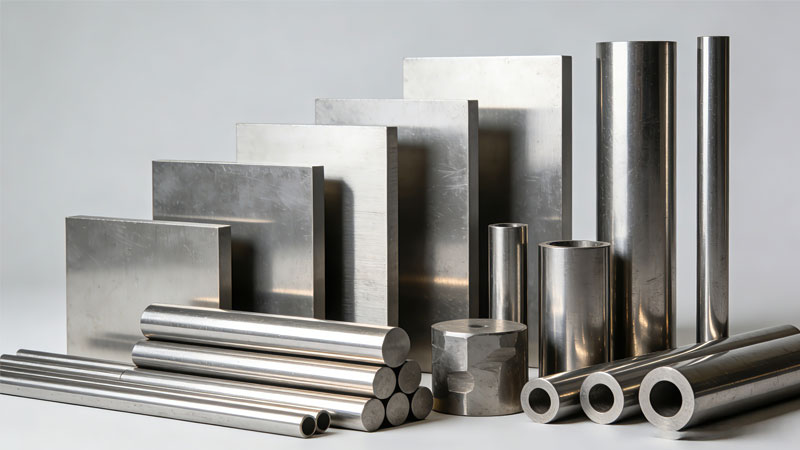
Titanium Alloys: A Comprehensive Guide to Grades, Properties, and Applications
Titanium and its alloys have established themselves as materials of choice for demanding engineering applications across aerospace, medical, chemical processing, and marine industries. The unique combination of high strength-to-weight ratio, exceptional corrosion resistance, and excellent mechanical properties positions titanium grades as superior solutions where performance and reliability are non-negotiable.
The allotropic behavior of titanium enables diverse microstructural variations through controlled thermomechanical processing. This metallurgical flexibility allows a relatively small number of titanium grades to serve a remarkably broad spectrum of properties and applications, particularly among titanium alloys with a two-phase alpha-beta crystal structure.
The Workhorse: Ti-6Al-4V (Grade 5)
The most widely utilized titanium grade is Ti-6Al-4V, an alpha-beta alloy that has become the industry standard for high-performance applications. This alloy is exceptionally well understood and demonstrates remarkable tolerance to variations in fabrication operations, despite having relatively poor room-temperature formability compared to steel and aluminum. Ti-6Al-4V exhibits limited section size hardenability and is most commonly employed in the annealed condition, where it offers an optimal balance of strength, ductility, and fracture toughness.
Commercially Pure Titanium Grades
For applications requiring exceptional corrosion resistance and formability, commercially pure titanium grades provide reliable solutions. Grades 1, 2, 3, and 4 are available in bar and billet form, with increasing oxygen content and corresponding strength levels from Grade 1 (softest, most formable) to Grade 4 (highest strength among commercially pure grades). These materials are widely specified for chemical processing equipment, heat exchangers, and marine components where corrosion resistance is paramount.
Alpha and Near-Alpha Alloys
Alpha alloys, characterized by their excellent weldability and high-temperature creep resistance, serve applications requiring elevated temperature performance. Notable alpha and near-alpha alloys include:
-
Ti-5Al-2.5Sn (Grade 6): Offers good creep resistance and oxidation stability at elevated temperatures
-
Ti-8Al-1Mo-1V: Designed for high-temperature applications up to 500°C
-
Ti-6Al-2Sn-4Zr-2Mo: Provides excellent high-temperature strength for gas turbine engine components
Alpha-Beta Alloys
The alpha-beta alloy family represents the most versatile category of titanium materials, offering combinations of strength, ductility, and fabricability that can be tailored through heat treatment. Key alpha-beta alloys include:
-
Ti-6Al-4V (Grade 5 and Grade 24): The industry standard with excellent balance of properties
-
Ti-6Al-6V-2Sn: Higher strength variant for aerospace structural applications
-
Ti-4Al-4Mo-2Sn (IMI 550): Offers good strength and creep resistance
-
Ti-4Al-4Mo-4Sn-0.5Si-0.1C (IMI 551): Enhanced high-temperature performance
Beta and Near-Beta Alloys
Beta and near-beta titanium alloys offer exceptional hardenability, high strength, and excellent cold formability in the solution-treated condition. These alloys can achieve very high strength levels through aging treatment. Notable beta alloys include:
-
Ti-3Al-8V-6Cr-4Zr-4Mo (BETA-C): High strength with excellent corrosion resistance
-
Ti-10V-2Fe-3Al (TIMETAL 10.2.3): High strength with good fracture toughness
-
Ti-15V-3Cr-3Sn-3Al (TIMETAL 15.3): Excellent cold formability with high strength after aging
-
Ti-15Mo (IMI 205): High strength with excellent corrosion resistance
-
TIMETAL 100: Ultra-high strength beta alloy for demanding applications
Titanium Casting Alloys
For complex geometries and near-net-shape components, titanium casting alloys provide design flexibility while maintaining the performance characteristics of wrought materials. Casting grades include commercially pure titanium Grades 2, 3, and 4, as well as Ti-6Al-4V (Grades 5 and 24), Ti-0.2Pd (Grade 7), Ti-5Al-2.5Sn (Grade 6), Ti-15V-3Cr-3Sn-3Al (TIMETAL 15.3), TIMETAL 1100, and Ti-5.8Al-4Sn-3.5Zr-0.7Nb (IMI 834).
Application-Based Classification
By application, titanium alloys can be systematically categorized into three main groups:
1. Corrosion Resistant Grades: Commercially pure titanium (Grades 1-4) and palladium-containing grades (Grades 7, 11, 17) offer exceptional resistance to corrosive media including seawater, chlorides, oxidizing acids, and industrial chemicals. These materials serve chemical processing, desalination, and marine applications.
2. High Strength Grades: Alpha-beta and beta alloys such as Ti-6Al-4V, Ti-10V-2Fe-3Al, and BETA-C provide strength levels ranging from 900 MPa to over 1400 MPa after appropriate heat treatment. These materials are specified for aerospace structures, automotive components, and high-performance sporting goods.
3. High Temperature Grades: Near-alpha alloys including Ti-6Al-2Sn-4Zr-2Mo and IMI 834 maintain their mechanical properties at elevated temperatures up to 600°C, making them ideal for gas turbine engine components, exhaust systems, and hypersonic vehicle structures.
Structural Types
From a metallurgical perspective, titanium alloys are classified into three structural categories:
-
Alpha Alloys: Single-phase alpha microstructure offering excellent weldability, creep resistance, and high-temperature stability
-
Alpha-Beta Alloys: Two-phase microstructure providing versatility in mechanical properties through heat treatment and thermomechanical processing
-
Beta and Near-Beta Alloys: Beta-stabilized microstructures capable of achieving very high strength levels through aging treatment while maintaining good fabricability
ZYTC Alloy: Your Titanium Solutions Partner
At ZYTC Alloy, we offer a comprehensive range of titanium products across all major grades and forms. Our capabilities include bar, billet, sheet, plate, strip, wire, and custom forgings manufactured to ASTM, AMS, and EN standards. Whether your application demands the corrosion resistance of commercially pure titanium, the versatility of Ti-6Al-4V, or the ultra-high strength of beta alloys, we provide certified materials with full traceability and process-driven quality assurance.
With fast delivery cycles, competitive pricing, and technical expertise across the titanium alloy spectrum, ZYTC Alloy is equipped to support your most demanding projects. Contact us to discuss your titanium material requirements.
Contact Us
ZYTC Alloy Delivers ASTM B167 Alloy 617 Seamless Pipe for Oil Industry Applications
High-Temperature Alloy Materials in Automotive and Train Solutions
Related Article


