Ti-6Al-4V is the most widely used titanium alloy, accounting for approximately 50% of total titanium consumption globally. This alpha-beta alloy combines high strength (yield strength up to 862 MPa) with low density (4.42 g/cm³)—approximately 56% of steel—resulting in an exceptional strength-to-weight ratio. It offers excellent corrosion resistance, heat treatability (sections up to 25mm), and service capability up to 400°C (750°F), making it the preferred material for aerospace structures, medical implants, and high-performance industrial components .
1. Product Specifications & Physical DataZYTC Alloy supplies UNS R56400 in comprehensive mill forms for aerospace, medical, marine, and industrial applications requiring verified mechanical properties and complete material traceability. Available Forms: Bar, billet, plate, sheet, strip, wire, forgings, rings, extrusions, castings, and welding wire . Specifications: AMS 4928 (bar/forgings), AMS 4911 (sheet/plate), ASTM B265 (sheet/plate), B348 (bar/billet), B381 (forgings), ASTM F136 (medical implant grade), ISO 5832-3 (surgical implants), MIL-T-9046 .
| Chemical Composition (Weight %) | Ti-6Al-4V Specification |
|---|
| Titanium (Ti) | Balance | | Aluminum (Al) | 5.50 - 6.75 | | Vanadium (V) | 3.50 - 4.50 | | Iron (Fe) | 0.30 - 0.40 max. | | Oxygen (O) | 0.20 max. | | Carbon (C) | 0.08 max. | | Nitrogen (N) | 0.05 max. | | Hydrogen (H) | 0.015 max. | | Yttrium (Y) | 0.005 max. | | Other, each | 0.10 max. | | Other, total | 0.40 max. |
| Physical Properties | Metric | Imperial |
|---|
| Density | 4.42 - 4.43 g/cm³ | 0.160 - 0.161 lb/in³ | | Beta Transus | 980 - 1000°C | 1800 - 1830°F | | Modulus of Elasticity | 110 - 114 GPa | 16.0 - 16.5 × 10⁶ psi | | Poisson's Ratio | 0.31 - 0.34 | 0.31 - 0.34 | | Thermal Conductivity (RT) | 6.7 - 7.5 W/m·K | 46 - 52 BTU·in/hr·ft²·°F |
| Mechanical Properties (Annealed Bar) | Section Size | Metric | Imperial |
|---|
| Tensile Strength (min.) | < 50 mm (2") | 931 MPa | 135 ksi | | Yield Strength (min.) | < 50 mm (2") | 862 MPa | 125 ksi | | Elongation (min.) | < 50 mm (2") | 10% | 10% | | Reduction of Area (min.) | < 50 mm (2") | 25% | 25% | | Tensile Strength (min.) | 50-100 mm (2-4") | 896 MPa | 130 ksi | | Yield Strength (min.) | 50-100 mm (2-4") | 827 MPa | 120 ksi | | Elongation (min.) | > 100 mm (4") | 8% | 8% |
| Mechanical Properties (Annealed Sheet) | Thickness | Metric | Imperial |
|---|
| Tensile Strength | 0.6-1.6 mm (0.025-0.063") | 924 MPa | 134 ksi | | Yield Strength | 0.6-1.6 mm | 869 MPa | 126 ksi | | Elongation | 0.6-1.6 mm | 8% | 8% | | Tensile Strength | 1.6-4.8 mm (0.063-0.1875") | 924 MPa | 134 ksi | | Elongation | 1.6-4.8 mm | 10% | 10% | | Tensile Strength | 4.8-100 mm (0.1875-4.0") | 896 MPa | 130 ksi |
2. Fabrication & Material ComparisonTi-6Al-4V requires specific fabrication techniques due to its high strength, low thermal conductivity, and chemical reactivity at elevated temperatures. Heat Treatment: Annealing: 700-785°C (1300-1450°F) × 1-4 hours, air cool; stress relief after cold working . Solution Treatment + Aging (STA): Solution 900-955°C (1650-1750°F), water quench; age 480-595°C (900-1100°F) × 2-8 hours, air cool .
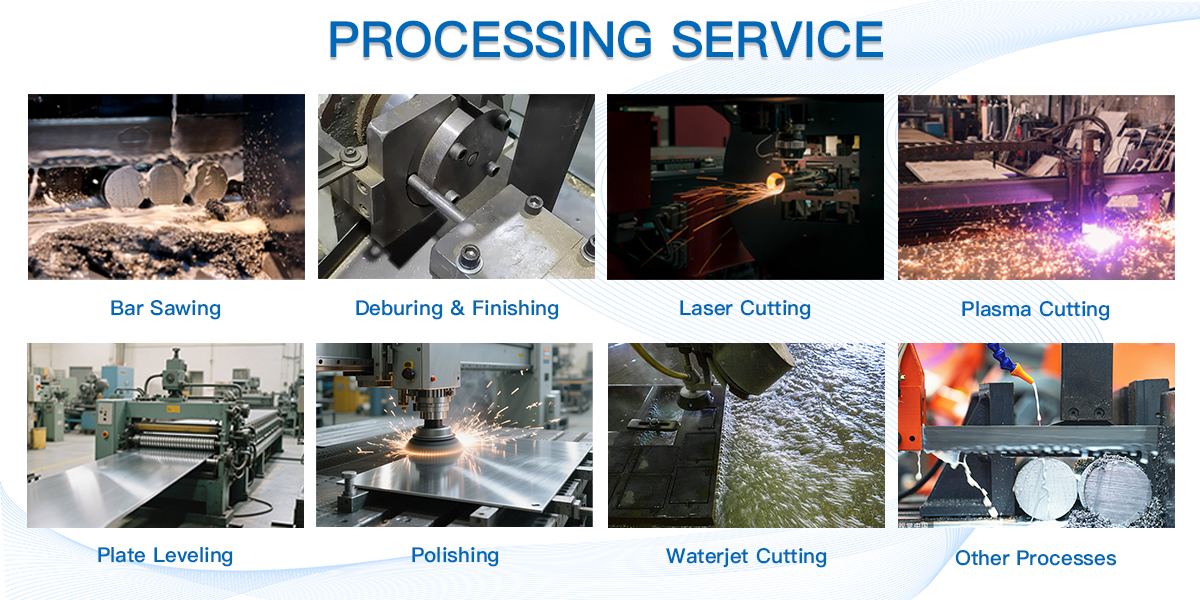
Hot Working: Forge 845-1040°C (1550-1900°F); critical to maintain temperature below beta transus (980-1000°C) to preserve alpha-beta microstructure . Machining: Requires ample coolant to prevent workpiece heating and tool wear; tendency to gall and seize requires sharp tools, positive rake angles, and rigid setups; low cutting speeds and high feed rates recommended . Welding: Weldable using GTAW, GMAW, plasma arc, and electron beam; must be shielded with inert gas to prevent oxygen/nitrogen contamination. Pre-heat and post-weld stress relief may be required . Surface Treatment: Oxidized surface layer (alpha case) from hot working must be removed mechanically or chemically to restore properties . Polishability: High inclusionary cleanliness permits exceptional finish—critical for medical and appearance applications . Material Comparison: vs. Ti-6Al-4V ELI: Lower interstitial grade for enhanced fracture toughness and ductility; specified for fracture-critical aerospace and medical applications . vs. Ti-3Al-2.5V: Higher strength; Grade 9 selected for hydraulic tubing where formability more important . vs. Ti-5Al-2.5Sn: Alpha alloy with better weldability but lower strength; 6-4 offers superior strength-to-weight . vs. 17-4PH Stainless: Half the density; comparable strength; superior corrosion resistance .
3. ApplicationsAerospace: Airframe components, structural parts, landing gear, wing boxes, fuselage frames, engine pylons, fasteners Aero-Engine: Compressor blades, discs, casings, fan blades, vanes Medical: Surgical implants (hip stems, knee components, bone plates), instruments, dental implants (ASTM F136/ISO 5832-3) Marine: Propeller shafts, seawater piping, pressure vessels, submarine components Offshore Oil & Gas: Risers, completion equipment, subsea hardware Autosport: Connecting rods, valves, suspension components, chassis parts Chemical Processing: Reactor vessels, heat exchangers, pumps, valves Defense: Armor plate, missile components, ordnance hardware
Contact ZYTC Alloy for certified Ti-6Al-4V materials with complete traceability, AMS/ASTM specifications, technical datasheets, and competitive pricing on standard sizes or custom-forged components. Email: daisy@zytcsteel.com WhatsApp/WeChat: +86 17335753350 |