Alloy U-500 AMS 5751 Turbine Bar & Forgings
Alloy U-500 (UDIMET® alloy 500, commonly written Udimet 500) is a gamma-prime strengthened Ni-Co-Cr-Mo superalloy with one of the longest service records in hot-section hardware. Developed for turbine blades, discs and fasteners, it retains high tensile and creep strength to roughly 870 °C (1600 °F), and its balanced Cr/Co/Mo chemistry keeps oxidation and hot-corrosion behaviour stable over long exposure.
The alloy is unusual in being used both as a wrought product and as an investment casting: bar, forgings and rings are procured to AMS 5751 (consumable-electrode or vacuum-induction melted, solution + stabilisation + precipitation heat treated), while cast blades and vanes follow OEM casting specs. We supply the wrought side — bar, forged rings and machined blanks with full melt traceability.
1. Wrought or casting — where U-500 fits your design
Wrought (AMS 5751) — this page
| Casting (OEM casting specs)
|
2. Chemical Composition (typical, weight %)
| Element | Nominal / Limit | Role in the alloy |
|---|---|---|
| Nickel (Ni) | Balance | Gamma matrix; base for γ′ precipitation |
| Chromium (Cr) | 17.5–19.0 | Oxidation and hot-corrosion resistance |
| Cobalt (Co) | 16.5–19.0 | Solution strengthening; stabilises γ′, raises creep resistance |
| Molybdenum (Mo) | 3.0–4.0 | Solution strengthening; carbide former |
| Aluminium (Al) | ~2.9 | γ′ (Ni₃Al) precipitation strengthening |
| Titanium (Ti) | ~2.9 | γ′ strengthening; raises γ′ volume fraction |
| Carbon (C) | 0.05–0.10 | Grain-boundary carbides for rupture life |
| Boron (B) / Zirconium (Zr) | 0.005 / 0.05 | Grain-boundary strengthening and ductility |
| Iron (Fe) | ≤4.0 (residual) | Impurity-controlled |
Limits above follow the AMS 5751 chemistry; acceptance analysis is that of the applicable revision and the purchase order, reported on the EN 10204 certificate for each melt.
3. Mechanical Properties (fully heat-treated, typical)
| Property | Room temperature | Elevated temperature |
|---|---|---|
| Tensile strength | 1200–1400 MPa (174–203 ksi) | ~1000 MPa (145 ksi) at 760 °C / 1400 °F |
| Yield strength (0.2 %) | 800–950 MPa (116–138 ksi) | High residual yield through the 650–800 °C band |
| Elongation | 10–20 % | — |
| Stress-rupture | — | >100 h at 815 °C / 345 MPa (1500 °F / 50 ksi) |
Typical design-guide values for the fully heat-treated condition; property scatter depends on melting route, section size and heat-treatment schedule. Acceptance values are those of AMS 5751 and the purchase order — request the certified test report for the actual lot.
4. Heat Treatment — why there is no single “the” schedule
AMS 5751 requires U-500 to be supplied in the solution-treated, stabilised and precipitation-aged condition. The exact temperatures and hold times are set by the applicable revision and by the component design: turbine-disc practice, fastener practice and blade practice use deliberately different ageing schedules, because U-500’s strength and stress-rupture behaviour are highly sensitive to the γ′ size distribution that each schedule produces.
Practical consequences for buyers:
- Specify the end use with the RFQ (disc, fastener, ring, blade repair) so the correct schedule is applied and certified.
- If your drawing references an OEM heat-treat specification, send it with the enquiry — we process and certify to it.
- Do not re-heat-treat machined U-500 parts without a qualified schedule; uncontrolled ageing can drop stress-rupture life well below design intent.
5. Physical Properties (typical)
| Property | Value | Imperial |
|---|---|---|
| Density | ~8.05–8.12 g/cm³ | 0.291–0.294 lb/in³ |
| Melting range | 1316–1371 °C | 2400–2500 °F |
| Thermal conductivity, RT | ~11.2 W/m·K | — |
| Mean CTE, 20–800 °C | ~15.3 μm/m·°C | ~8.5 μin/in·°F |
| Magnetic behaviour | Paramagnetic (no Curie point in service range) | — |
6. Applications
Aerospace gas turbines
| Industrial & energy
|
7. Specifications
| Specification | Covers |
|---|---|
| AMS 5751 | Bar, forgings and rings — solution, stabilisation and precipitation heat treated; consumable electrode or vacuum induction melted |
| Trade designation | UDIMET® alloy 500 (Special Metals); procured and referenced as U-500 / Udimet 500 |
| UNS | No widely-used UNS number is assigned to this grade — specify by AMS 5751 and the U-500 designation; beware of datasheets quoting random UNS codes |
8. FAQ
Q: How does U-500 compare with Waspaloy (UNS N07001)?
Both are γ′-strengthened Ni-Co-Cr alloys of the same generation serving up to about 870–900 °C. Selection usually follows the OEM’s qualified material list and the property balance required (U-500 carries a higher Cr level for hot-corrosion service). We supply both — send the application and we will quote the better-fit grade.
Q: Can U-500 be welded?
Not as a fabrication route: like most high γ′ alloys it is prone to strain-age cracking during post-weld heat treatment. Repair welding of castings is possible with preheat, low-energy parameters and a full re-solution treatment, and should follow a qualified repair procedure.
Q: Why do your properties show a range instead of one number?
Because heat-treatment schedule, melting route and section size all shift the balance between tensile strength, stress-rupture life and ductility. The certified test report for your lot — against AMS 5751 and your order — is the governing document.
9. Why ZYTC Alloy
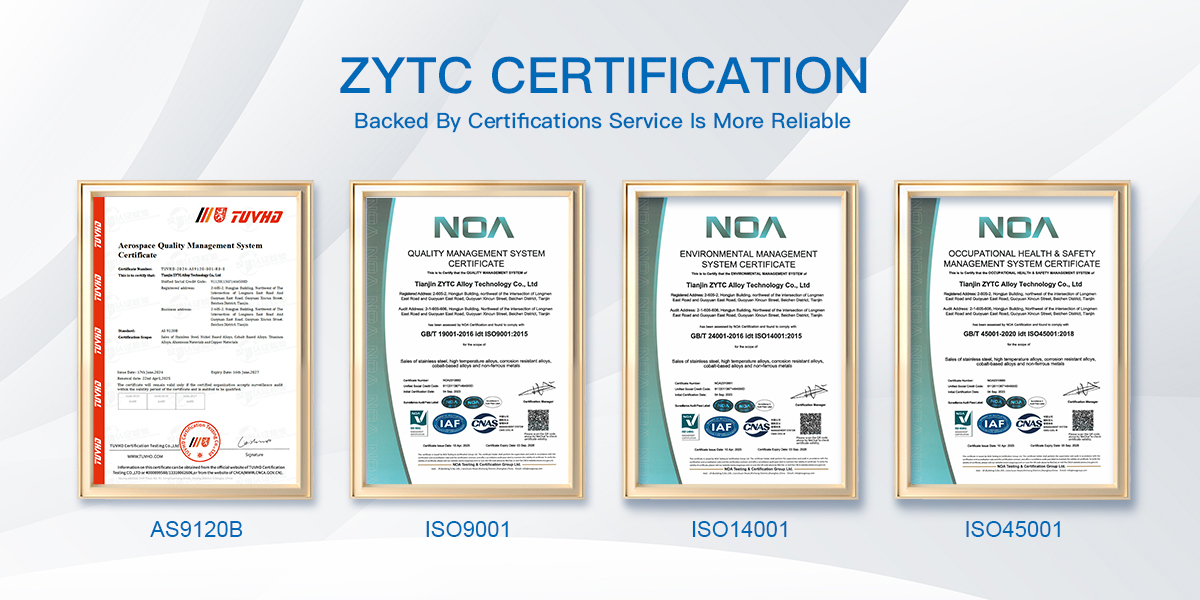
- Bar, forgings and rolled rings with AMS 5751 processing and full EN 10204 traceability
- Heat treatment to the schedule your drawing or OEM spec calls out, with certification of the actual cycle
- Machined blanks from bar and rings to reduce your cycle time
- Matching supply of Waspaloy (UNS N07001) and other γ′ grades for mixed-material builds
Send us your drawing, size list and end-use — we confirm condition, schedule and lead time within one working day.
UDIMET® is a registered trademark of Special Metals Corporation. The U-500 designation is used here for grade identification only.