321H is the high-carbon variant of titanium-stabilized 321 stainless steel, specifically formulated for enhanced creep and stress-rupture strength at temperatures above 538°C (1000°F). With controlled carbon content (0.04-0.10%), it offers superior high-temperature mechanical properties while maintaining excellent resistance to sensitization and intergranular corrosion through titanium stabilization. This grade is the preferred choice for aircraft exhaust systems, jet engine components, and chemical processing equipment requiring sustained strength at elevated temperatures .
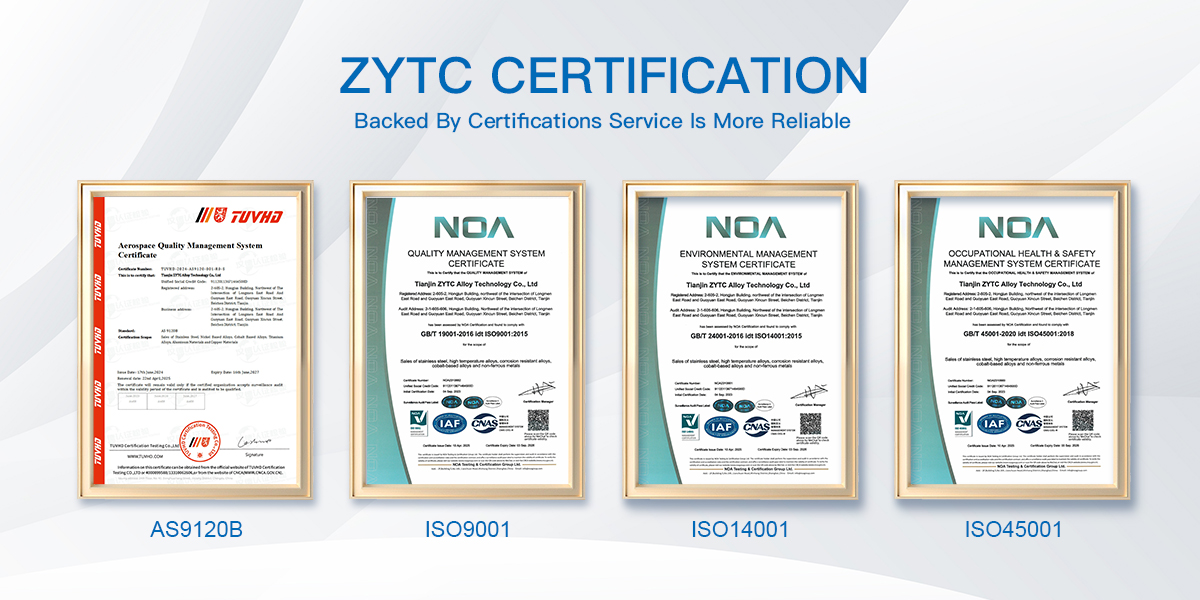
1. Product Specifications & Physical DataZYTC Alloy supplies 321H stainless steel in comprehensive mill forms for high-temperature applications requiring verified mechanical properties and complete material traceability. Available Forms: Sheet, strip, plate, bar (round, hex, flat, square), tube, and forging stock . Specifications: ASTM A240, ASTM A276, ASTM A312, UNS S32109, EN 10088-2 (high-carbon variant of 1.4541) .
| Chemical Composition (Weight %) | 321H Stainless Specification |
|---|
| Chromium (Cr) | 17.0 - 19.0 | | Nickel (Ni) | 9.0 - 12.0 | | Carbon (C) | 0.04 - 0.10 | | Titanium (Ti) | 5 × C min - 0.70 max. | | Manganese (Mn) | 2.0 max. | | Silicon (Si) | 1.0 max. | | Phosphorus (P) | 0.045 max. | | Sulfur (S) | 0.030 max. | | Iron (Fe) | Balance |
| Physical Properties | Metric | Imperial |
|---|
| Density | 7.9 - 8.0 g/cm³ | 0.285 - 0.289 lb/in³ | | Melting Point | 1400 - 1425°C | 2550 - 2600°F | | Modulus of Elasticity | 193 GPa | 28,000 ksi | | Thermal Conductivity (RT) | 16.1 W/m·K | 112 BTU·in/hr·ft²·°F | | Thermal Expansion (20-100°C) | 16.5 µm/m·°C | 9.2 µin/in·°F |
| Mechanical Properties (Minimum) | Value | Unit |
|---|
| Tensile Strength | 515 MPa | 75 ksi | | Yield Strength (0.2% offset) | 205 MPa | 30 ksi | | Elongation (in 50mm) | 40% | 40% | | Hardness (Brinell) | 187 max. | 187 max. |
2. Operating Conditions & Selection Criteria321H is specified when designers require enhanced elevated-temperature strength beyond standard 321, particularly for components operating above 538°C. Service Temperature Range: Optimized for continuous operation up to 816°C (1500°F); excellent oxidation resistance through this range . High-Carbon Advantage: Controlled carbon content (0.04-0.10%) provides superior creep and stress-rupture strength compared to standard 321 at temperatures above 538°C . Titanium Stabilization: Titanium addition (min. 5× carbon) prevents chromium carbide precipitation, maintaining resistance to intergranular corrosion despite higher carbon . Creep Strength: Enhanced high-temperature strength for stressed components in jet engines and chemical processing . Oxidation Resistance: Excellent resistance to scaling and oxidation at elevated temperatures due to chromium content . Low-Temperature Toughness: Maintains good mechanical properties and impact resistance at cryogenic temperatures .
3. Fabrication & Material ComparisonHeat Treatment: Solution anneal 950-1120°C (1740-2050°F), rapid cool; cannot be hardened by heat treatment . Forming: Excellent ductility and formability in annealed condition; similar to standard 321 . Machining: Similar to 304; requires sharp tools, positive feeds, and adequate coolant to manage work hardening . Welding: Excellent weldability using all standard fusion and resistance methods without pre-heat; post-weld annealing recommended for maximum corrosion resistance in severe service . Material Comparison: vs. 321 Stainless: Higher carbon provides superior creep strength above 538°C; identical titanium stabilization ensures sensitization resistance . vs. 347H: Titanium-stabilized vs. niobium-stabilized; 321H offers better oxidation resistance; 347H offers higher creep strength in some applications . vs. 304H: Titanium stabilization prevents sensitization; essential for applications requiring intergranular corrosion resistance after elevated temperature exposure . vs. 309/310: Lower chromium and nickel; 321H offers cost-effective high-temperature performance for applications up to 816°C .
4. ApplicationsAerospace: Aircraft exhaust stacks, manifolds, jet engine parts Chemical Processing: High-temperature reactors, piping, vessels, weld equipment Power Generation: Boiler components, superheater tubes, heat exchangers Industrial Furnaces: Furnace parts, heat treatment equipment, heating element supports Petrochemical: Elevated temperature process equipment, reformers Welded Fabrications: Components requiring post-weld high-temperature service
Contact ZYTC Alloy for certified 321H stainless steel materials with complete traceability, ASTM specifications, technical datasheets, and competitive pricing on standard sizes or custom-fabricated components. Email: daisy@zytcsteel.com WhatsApp/WeChat: +86 17335753350 | |